Many pavement teams struggle with a related confusion: mixing up full depth milling with full-depth reclamation (FDR). They sound similar. They are not the same process.
This article breaks down what full depth milling is, how it works step by step, where it's applied, and what affects the outcome — including the cutting tool technology that determines how much downtime your project eats up.
TL;DR
- Full depth milling removes the full asphalt layer (often 3-5+ inches) to the aggregate base, unlike partial-depth milling
- Best for widespread structural distress, multiple prior overlays, or curb/drain elevation problems
- Process flow: evaluate, set depth, mill, collect RAP, clean, repave
- Cutting tool choice (carbide picks vs. rolling-cut designs) drives productivity and cost
- Skip it when the base has failed or issues are purely cosmetic
What Is Full Depth Milling?
Full depth milling is the removal of the asphalt surface and binder layers down to the aggregate base or subgrade, using a cold planer fitted with rotating cutting teeth. It leaves a clean, structurally sound base ready for full-thickness asphalt replacement.
FHWA classifies this as Class IV cold milling — removing the entire depth of existing surfacing down to base or subgrade, as opposed to lighter classifications that only correct surface irregularities or maintain a uniform cross slope.
Full depth milling is often confused with two related processes:
- Partial-depth milling removes only 1.5-2 inches of surface course, leaving the binder layer intact
- Full-depth reclamation (FDR) pulverizes and mixes the pavement with underlying base material in place, rather than removing and hauling it away
There's no single universal inch threshold for "full depth." It's defined by reaching the bottom of the existing bound pavement, so actual depth depends on the original pavement thickness and project plans.
Why Full Depth Milling Is Used in Pavement Rehabilitation
Full depth milling is used when surface distress has worked its way into the binder layer. At that point, a shallow mill just isn't enough — you'd be paving over a problem instead of removing it.
Height creep is a common trigger. Repeated overlays without full removal gradually raise the road surface above curbs, drains, and ADA ramps. Eventually the only fix is milling everything back down to grade.
Skip full depth milling when it's needed, and here's what typically happens:
- Reflective cracking migrates up through the new overlay within a season or two
- Poor bonding between old and new layers accelerates delamination
- The new overlay fails prematurely, often before it's paid for itself
Recycling makes the economics work here too. In 2024, U.S. asphalt producers accepted an estimated 119.6 million tons of reclaimed asphalt pavement (RAP), with 101.4 million tons going straight back into new asphalt mixtures. Milling instead of full reconstruction keeps that material in the supply chain rather than sending it to a landfill.
Full depth milling is generally a contractor or engineer-driven best practice, not a strict regulatory mandate. That said, DOT specifications frequently dictate specific depth classes on public projects, so the "choice" often comes with guardrails.
How Full Depth Milling Works (Process Flow)
The milling machine's rotating drum cuts progressively through the surface, binder, and into the base, guided by depth and slope controls that keep the cut accurate within roughly 1/8 inch along each edge.
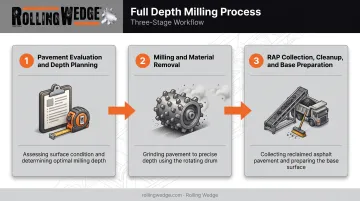
Before the drum ever touches pavement, crews need pavement evaluation data, a target depth and profile, and the right equipment (drum width, tooth spacing) for the job.
Step 1: Pavement Evaluation and Depth Planning
Crews assess whether distress extends into the base, then set the milling depth accordingly. They mark utilities and obstacles ahead of time, since a drum that hits an unmarked valve box is an expensive mistake.
Step 2: Milling and Material Removal
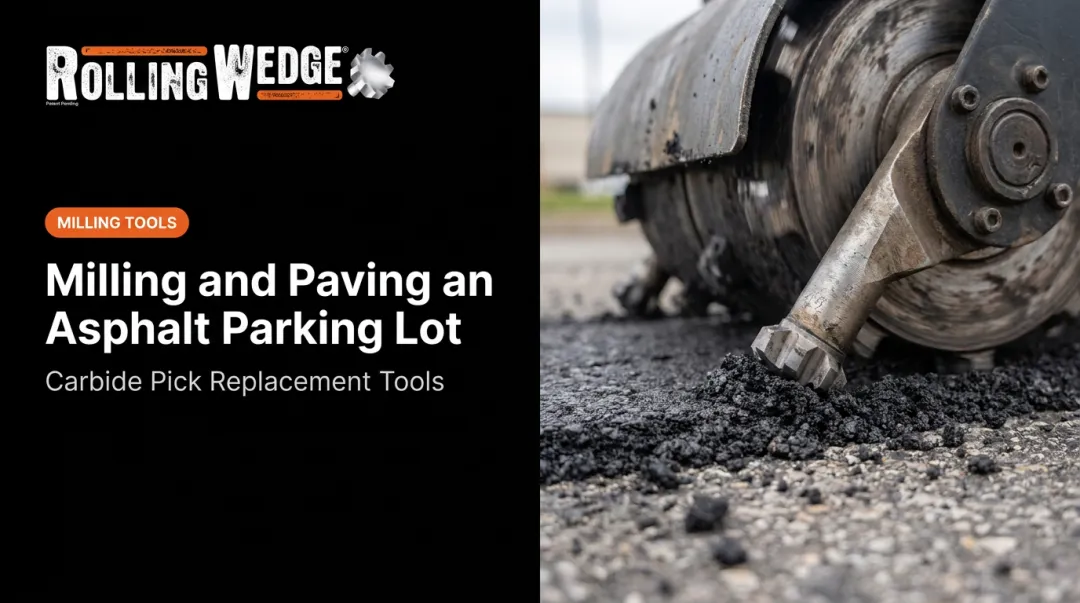
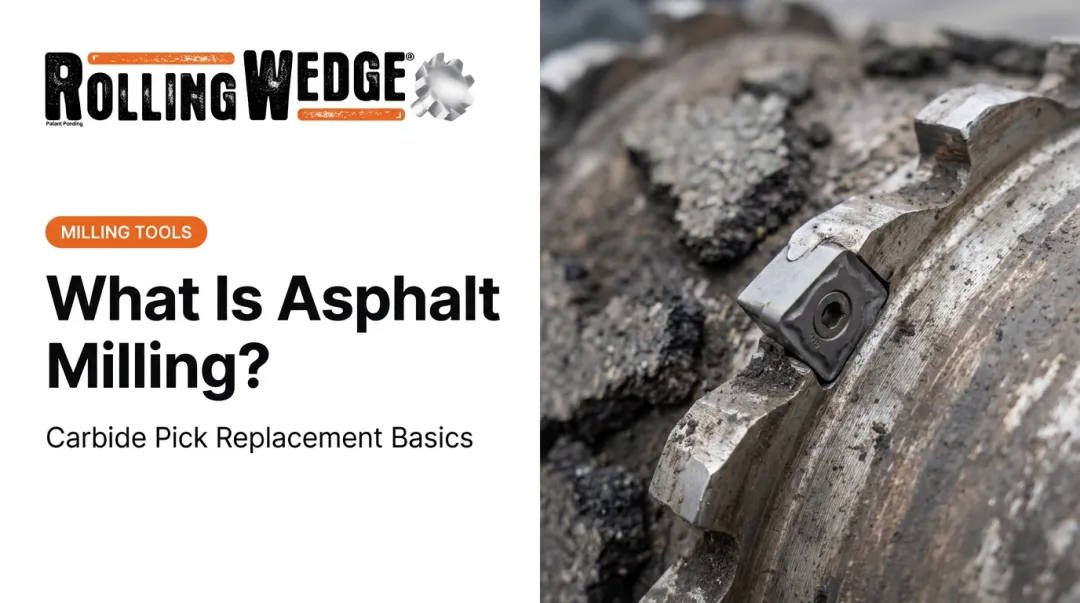
This is where cutting tool design starts to matter. Traditional carbide picks cut with a fixed-point, hammer-and-chisel action: repeated impacts that generate heat and wear the tooth down fast.
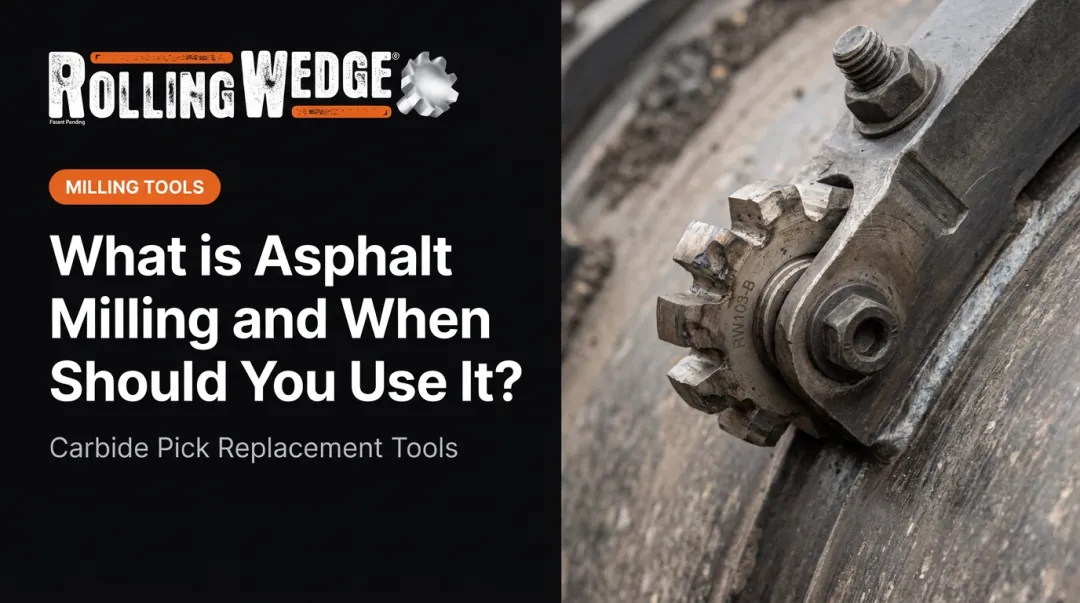
Rolling Wedge tools use a rolling-wedging-lifting action instead. Nine carbide teeth roll into the material, wedge it, and lift the loosened cuttings away rather than hammering them apart. The design places the material into tension at roughly 20% of its compressive strength, so it takes less force to pull the material apart than to chisel through it. In mixed asphalt/concrete or rebar-reinforced sections, that difference shows up as fewer stalls and fewer broken tools.
Water spray also plays a role during deep cuts, cooling the rotor and cutting tools while suppressing dust inside the drum housing.
Step 3: RAP Collection, Cleanup, and Base Preparation
The conveyor moves milled material (RAP) onto a discharge system and loads it directly into trucks for recycling. Once the pass is complete, crews sweep the exposed base and inspect it before any new material goes down.
Where Full Depth Milling Is Applied and What Affects the Results
Full depth milling shows up on:
- Highways and interstates
- Municipal roads with structural distress
- Large commercial parking lots
- Industrial yards carrying heavy repeated loads
It's typically a rehabilitation-stage decision, triggered by alligator cracking, multiple failed overlays, or signs of base-level failure, not a routine maintenance task.
A few factors that shape the outcome:
- Base condition — Subgrade stability determines how deep milling must go, and whether reconstruction needs to happen alongside it
- Mixed materials — Asphalt-over-concrete and rebar sections chew through carbide picks fast and can stall mid-pass; Rolling Wedge tools handle those transitions without stopping
- Equipment scale — Drum width and engine power need to match the project size, or you'll pay for it in downtime
- Tool replacement frequency — One of the biggest hidden cost drivers; frequent changeouts stall crews and inflate labor on multi-day jobs
- Traffic control and specs — Municipal scheduling constraints often dictate how the job gets phased
Tool Wear: A Real Cost Driver
Tool wear isn't a minor line item. In one documented field case, conventional carbide teeth wore out after as little as 50 feet of milling through abrasive river rock aggregate in south Texas — an extreme example, but it illustrates how fast things can go sideways with the wrong tooling.
By comparison, here's how the two approaches stack up on replacement intervals:
| Metric | Traditional carbide picks | Rolling Wedge tools |
|---|---|---|
| Replacement frequency | ~Twice weekly | Every 1-3 months |
| Drum changeout time (24" drum) | 1-2 hours | ~20 minutes |
| Tool-life ratio | Baseline | 10:1 |
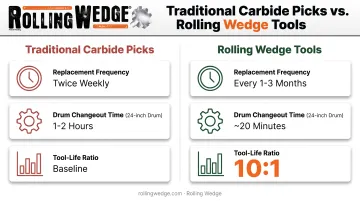
That gap between twice-weekly tooth changes and a 1–3 month interval adds up fast on a multi-day full depth project, especially once you factor in the shorter changeout time.
Common Issues, Misconceptions, and When Full Depth Milling May Not Be Right
The biggest misconception is that full-depth milling and full-depth reclamation (FDR) are interchangeable. They're structurally different. Milling removes and hauls away material. FDR pulverizes and reuses the base in place, typically stabilizing 4-12 inches of material rather than removing it.
A second mistake is assuming any deep cut automatically fixes base failure. It doesn't. If the subgrade itself is unstable, milling down to it just exposes the problem. Reconstruction may still be necessary.
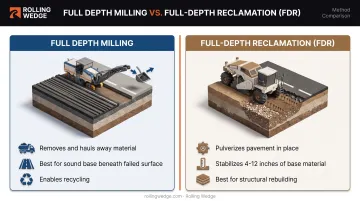
Full-depth milling may not be the right call when:
- Only the surface course is worn and the base remains sound (partial-depth milling is cheaper and faster)
- The base needs pulverizing and stabilizing rather than removal (FDR territory)
- Excessive surface deformation points to a soft subgrade or drainage issue milling alone won't fix
Choosing between milling and reclamation comes down to the rehabilitation objective. If you're rebuilding the structural layers, FDR fits better. If you're removing a failed surface to make way for new asphalt on a sound base, milling is the right tool.
Conclusion
Full depth milling removes the complete asphalt layer to expose a sound base for repaving. That sets it apart from partial milling's surface-only approach and from FDR's in-place pulverization strategy.
Understanding depth classes, base condition, and equipment or tooling choices separates a smooth project from one that hits cost overruns and premature failures.
The deepest possible cut isn't automatically the right one. Match the process and cutting technology to the actual pavement condition, and the rehabilitation is far more likely to hold up.
Frequently Asked Questions
How much does 1 ton of asphalt milling cost?
Cost depends on cut depth, haul distance, site access, and traffic control needs. There's no fixed national rate. Get project-specific quotes from contractors or current DOT bid tabs for accurate pricing.
How long does it take for asphalt millings to harden?
Loose RAP compacts and settles under traffic within days to weeks with proper mechanical compaction. True structural stabilization, however, takes longer and depends on the base mix design.
How deep can a milling machine mill?
Full-depth cuts typically run 3-5+ inches, matching pavement thickness. Heavy-duty cold planers can reach 13-14 inches in a single pass depending on drum size, though deeper cuts often work better in two passes.
What are the two types of milling?
Partial-depth milling removes only the surface course, usually 1.5-2 inches. Full-depth milling cuts through the binder layer down to the aggregate base or subgrade.
What's the difference between full-depth milling and full-depth reclamation?
Milling removes the asphalt and hauls it away for recycling. Reclamation pulverizes the pavement and mixes it with underlying base material to create a new stabilized base in place.
How often do milling teeth need to be replaced on a full depth project?
Traditional carbide picks may need replacement roughly twice a week on tough full-depth cuts. Rolling-cut tools like Rolling Wedge extend that interval to every 1-3 months.