Many contractors buy attachments based on price alone, then wonder why the "deal" never pays for itself. The real story is about labor replacement, billable hours, and how fast a tool earns back its cost. This guide breaks down the attachment categories delivering the strongest returns, explains how each one generates ROI, and helps you pick the right one for your business.
TL;DR
- Attachments boost profit by speeding up jobs, cutting manual labor, and opening paid service lines
- Strongest returns usually come from milling/planer tools, grapples, breakers, augers, and material handlers
- Buy for local demand, multi-job versatility, and the fastest path to payback
- Steady maintenance protects uptime, attachment ROI, and long-term earnings
Overview: Skid Steer Attachments in the U.S. Construction Market
A skid steer is really just a power source. Swap the bucket for a grapple, breaker, or auger through the quick-attach system, and the same machine performs an entirely different job in minutes. That flexibility is why attachments — not the base machine — often determine profitability.
The rental market backs this up. U.S. construction and general-tool rental revenue hit $83.3B in 2024, up 8% from the prior year.
74.5% of contractors surveyed had rented equipment in the previous year, and 75.9% did so for short-term or infrequent needs. That's a signal: if you're constantly renting a specific attachment, you're likely leaving money on the table by not owning it.
Below, we break down the attachments delivering the strongest returns for contractors nationwide.
Most Profitable Skid Steer Attachments for Maximizing Earnings
The attachments below were selected using four criteria: labor replacement, revenue-per-hour potential, versatility across job types, and consistent market demand.
Milling and Surface-Removal Attachments
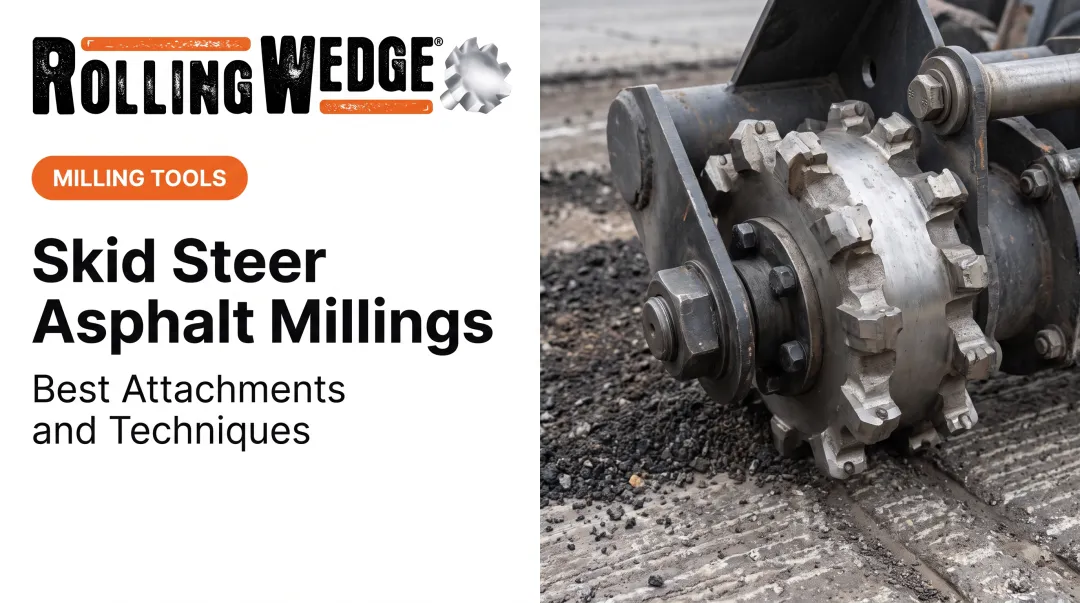
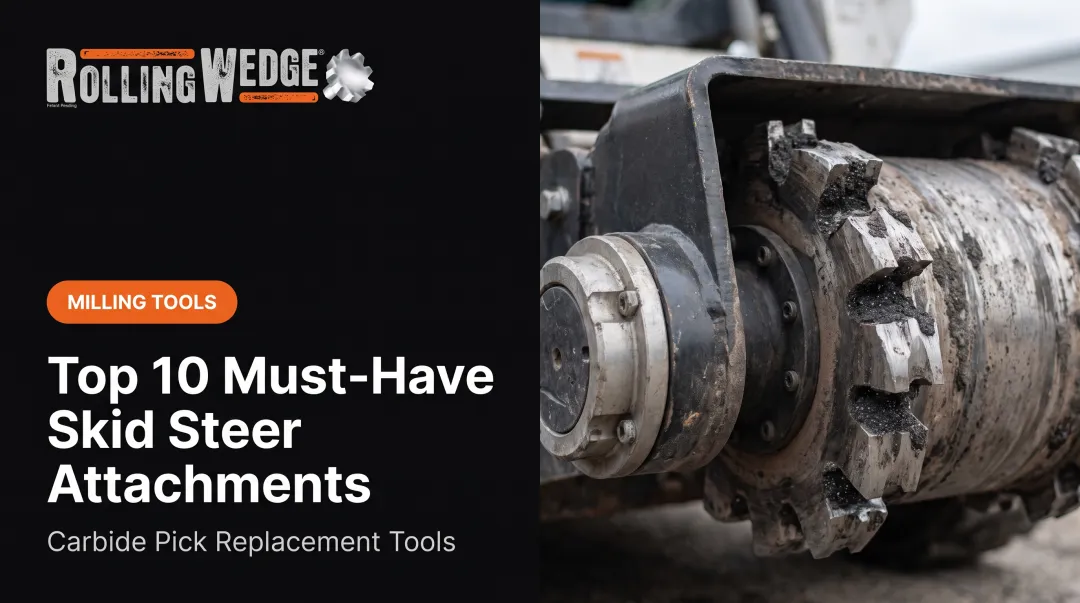
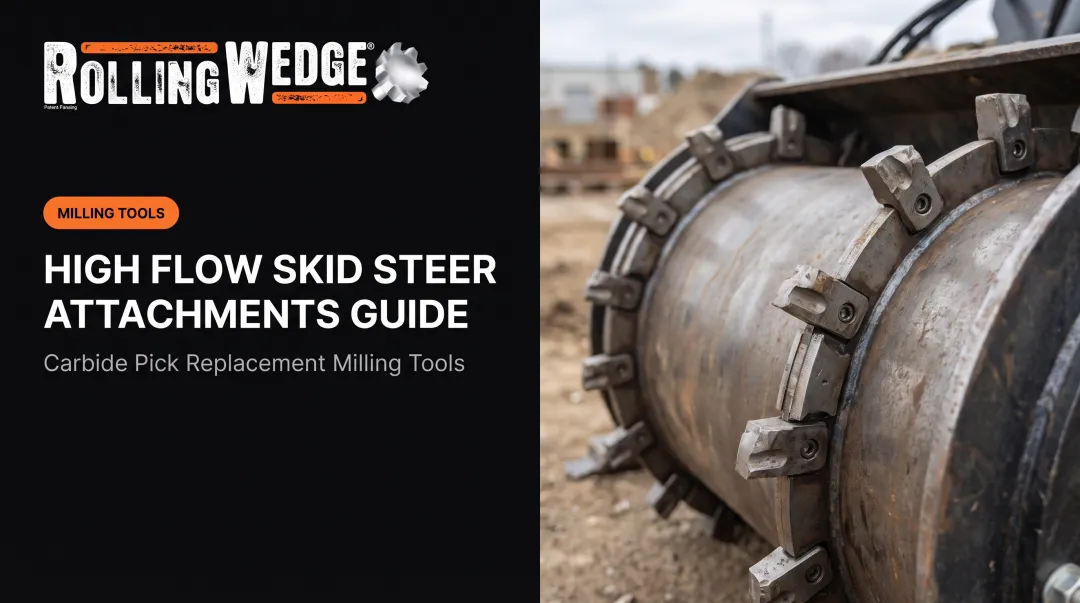
Rolling Wedge, LLC manufactures a proprietary rolling-wedging-lifting milling attachment as an alternative to standard carbide pick technology for asphalt and concrete removal. It uses a rolling motion instead of impact milling, which yields cleaner cuts, less operator fatigue, and less wear on the machine.
Measurable differentiators include:
- Tool replacement every 1–3 months, versus roughly twice a week for carbide picks
- 20-minute drum changeout on a 24-inch drum, compared to 1–2 hours for carbide-pick systems
- Ability to mill asphalt and concrete simultaneously without swapping tools mid-job
- Compatible with skid steer brands including Bobcat, Caterpillar, Kubota, Roadhog, Simex, and Virnig, plus large equipment like Roadtec
Rolling Wedge backs that durability with a **10-to-1 longevity warranty for asphalt milling applications**. In one roadway-joint evaluation, only 1.1% of carbide cutting edges tested were damaged or missing; Rolling Wedge tools are built to beat that kind of wear benchmark in the field.
| Best For | Key Advantage | Cost Factor |
|---|---|---|
| Municipalities, road contractors, pavement rehab crews | Reduced tool wear and downtime means more billable hours per week | Lower long-term maintenance costs vs. carbide-pick drums |
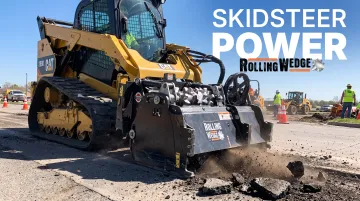
A Minnesota contractor in Rolling Wedge’s “Making the Cut” case study reported fewer mid-job tool swaps and more continuous milling time after switching drums, which directly protects billable hours.
Grapple Buckets and Demolition Grapples
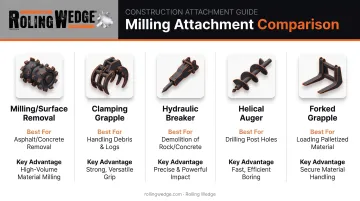
Grapples handle bulky debris, brush, and demolition material with one operator instead of a crew. Bobcat's lineup alone spans 36 to 86 inches wide, with industrial, root, utility, and rock-bucket variants targeting different debris types.
The real advantage is trip reduction. A grapple can move a large branch or slab in one motion. Without it, crews often cut material into smaller pieces or load by hand. Arkansas contractor D2Scapes reported finishing jobs faster after leaning on interchangeable attachments like grapples, cutting labor hours on debris and cleanup work.
| Best For | Key Advantage | Cost Factor |
|---|---|---|
| Demolition cleanup, storm debris, landscape removal | Cuts labor costs, speeds up site prep | Mid-range investment, fast payback from daily use |
Hydraulic Breakers
A breaker turns your skid steer into a mini demolition machine for concrete, asphalt, and rock. United Rentals' skid-steer breaker class runs 300–350 lbs with 500–1,100 blows per minute, drawing 10.5–22.5 gpm of hydraulic flow. That is enough force for slab demo without hiring out the job.
If your carrier already has the hydraulic capacity, a breaker attachment lets you skip renting a separate demo tool or mini-excavator for smaller jobs.
| Best For | Key Advantage | Cost Factor |
|---|---|---|
| Slab demo, curb removal, utility trenching prep | Expands job scope without subcontracting | Mid-range price, high revenue potential |
Augers (Standard, Rock, and High-Torque)
Augers replace a full digging crew with one operator. Bit sizes commonly range from 6 to 36 inches, and matching rotation speed to hole diameter matters: industry guidance suggests around 60 rpm for a 24-inch hole and closer to 120 rpm for an 8-inch hole. Too fast, and you scrape rather than dig; too slow, and production drags.
| Best For | Key Advantage | Cost Factor |
|---|---|---|
| Fence posts, deck footings, utility trenching | Reduces subcontractor costs, speeds linear-foot production | Low-to-mid investment, high recurring demand |
Material Handling Attachments (Pumps, Buckets, Dispensers)
Concrete pump attachments move dry mix or concrete during pours far faster than wheelbarrow crews. Bobcat's skid steer-compatible pump rates up to 18 yd³/hour on standard flow, and 28 yd³/hour on high flow, reaching 250 feet horizontally or two stories vertically.
| Best For | Key Advantage | Cost Factor |
|---|---|---|
| Concrete crews doing frequent pours | Completes pours faster with fewer laborers | Pays off quickly on high-frequency pour jobs |
How to Choose the Right Attachment for Your Business
Before buying, run through these questions:
- What slows your crew down most? If digging, hauling, or demo work eats up labor hours, that's your first attachment candidate.
- Are you renting the same tool repeatedly? Frequent rentals of breakers or milling drums are a clear signal to buy. 44.3% of contractors surveyed said renting made financial sense only for short-term needs, not ongoing ones.
- What does your region demand? Rocky terrain favors breakers, wooded regions favor mulchers, and paving-heavy markets favor milling attachments.
Still weighing the buy? Rolling Wedge offers a two-week trial program for qualifying customers and an online Milling Cost Comparison Tool to estimate savings versus carbide-pick costs.
Maintenance: Protecting Your Attachment's Profitability
Downtime is the enemy of profitability, and most downtime is preventable.
- Inspect daily. Check hoses, pins, and wear components before each shift. Small cracks or loose pins turn into expensive breakdowns fast.
- Service hydraulics and clean after every job. Correct fluid care and post-use cleaning extend component life and cut premature wear.
- Follow manufacturer replacement intervals. Rolling Wedge tools, for example, are designed for replacement every 1–3 months. Sticking to that schedule keeps downtime predictable instead of surprising.
Skipping these steps doesn't just risk breakdowns. It erodes the resale value you're counting on when it's time to trade up.
Frequently Asked Questions
How do I make the most money with a skid steer?
Pair versatile, high-demand attachments with smart pricing and consistent maintenance. This maximizes billable hours and keeps profit per job predictable rather than lost to downtime.
Is a skid steer a tax write-off?
Skid steers and attachments can often be depreciated or expensed under IRS Section 179, with a 2025 deduction limit of $2,500,000. Eligibility depends on business-use percentage and other factors, so consult a tax professional.
What is the most useful attachment for a skid steer?
It depends on your niche. Grapples, augers, and milling or breaker attachments consistently deliver strong utility across job types.
What attachments have the fastest payback period?
Milling, grapple, and material-handling attachments tend to pay back fastest, thanks to reduced rental costs and lower labor requirements per job.
How much can I charge for skid steer work with specialized attachments?
Rates vary by region, attachment type, and job complexity. Specialized work like milling or breaker jobs typically commands a premium over standard bucket work, since it requires fewer subcontracted trades.
Ready to Boost Your Skid Steer's Earning Potential?
Profitability comes from matching the right tool to the jobs slowing your crew down and the services you want to add. Judge each option on durability, tool life, and total cost of ownership—not purchase price alone.
If asphalt or concrete milling is part of your business, explore Rolling Wedge's Milling System for Skidsteer, available in 18-, 24-, 30-, and 40-inch drum widths. Call (309) 322-1600 to ask about the two-week trial program, or catch Rolling Wedge in person at PAVE/X 2026 (Booth 845, New Orleans) or CONEXPO-CON/AGG 2026 (Booth W42644, Las Vegas).