This is the reality of interstate concrete cutting work—a specialized trade where depth, reinforcement, and access can turn a routine job into a genuine engineering puzzle. This article breaks down the core cutting methods, walks through real business lessons from Interstate Sawing's decades in the field, covers what actually drives cost, and looks at equipment innovations changing how contractors approach mixed surfaces.
Key Takeaways
- Sawing, wire sawing, core drilling, and wall sawing each solve different concrete geometry problems
- Diversified services and robotics investment separate growing cutting firms from stagnant ones
- Costs swing widely with depth, rebar, access, and region: there's no flat national rate
- New milling technology is starting to replace traditional carbide tooling on mixed asphalt/concrete jobs
What Is Interstate Sawing? A Case Study in Concrete Cutting Excellence
Duke Long founded Interstate Sawing in 1996 with one truck and two saws. Nearly three decades later, the West Bend, Wisconsin company runs a multi-truck operation covering confined-space demolition, road sawing, core drilling, wall sawing, and wire sawing.
That diversification mattered. Starting as a road-sawing outfit limited the company to one type of client. Adding full-service cutting capabilities opened doors to industrial, municipal, and commercial work that a single-service shop simply can't bid on.
The Robotics Shift
Interstate added seven models of remote-controlled demolition robots and electric excavators to its fleet. The company credits that move with an 8-12x speed advantage over traditional manual demolition in confined spaces.
That's a company-reported figure, not an independently tested benchmark. Still, it tracks a broader industry pattern: robots let crews work in tight, hazardous spaces without the labor bottleneck of jackhammer crews.
The Kikkoman Foods Job
Interstate was hired to remove several hundred feet of drain trench at a Kikkoman Foods facility in Walworth, Wisconsin, using all-electric equipment inside a live food-production environment. The slab was expected to run 6-8 inches thick.
It turned out to be 36 inches.
Rather than a straight saw cut through the full depth, the crew:
- Sawed electrically down to 24 inches
- Used high-force hydraulic splitters to break the remaining depth
- Deployed robots to lift and load the broken concrete
- Excavated the underlying clay to 6 feet, still using electric equipment
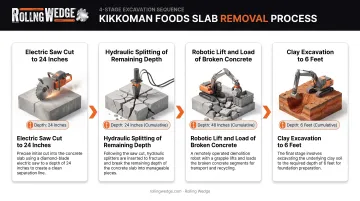
Duke Long reported the crew still hit the original timeline planned for the thinner slab (a claim from the job site, not a lab-controlled result). It shows what adaptable equipment and process flexibility can do on a live site.
Operational habits that made it possible:
- Doubled-up backup equipment so a failure doesn't stall the whole job
- Class A CDL-certified operators for equipment transport flexibility
- Fully stocked trucks so crews aren't waiting on parts mid-job
Common Methods of Concrete Cutting and Sawing
Method selection comes down to geometry. Crews weigh three factors before they pick a tool:
- Where the cut needs to happen
- How thick the material is
- How much access the crew has
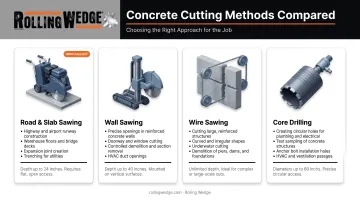
Road & Slab Sawing
Walk-behind or ride-on saws with a spindle-mounted diamond blade cut horizontal joints and slabs. This is the workhorse method for road repair, trench access, and utility work on flat, open surfaces where a machine can roll along the cut line.
Common uses include:
- Contraction joints
- Removal-section boundaries
- Trench cuts for utilities
Flat or slab sawing is standard horizontal cutting. It is not the same as leveling an uneven surface, which falls under grinding rather than sawing.
Wall Sawing
Wall saws mount on a track system and cut precise vertical or horizontal openings into concrete walls, including heavily reinforced ones. Husqvarna's WS 482 HF model, for example, handles up to a 29-inch cutting depth with a 63-inch blade.
Wire Sawing
Wire sawing takes over when a shape or location does not suit a circular blade. Typical jobs include oversized structural sections, curved cuts, and oddly angled demolition work. A diamond wire loop runs at high speed and wears through material regardless of geometry.
Core Drilling
Core drills bore circular holes for plumbing runs, utility penetrations, ventilation, or structural inspection access. Handheld units work well for smaller, occasional holes or tight, sensitive environments where a large rig cannot fit.
Cost Factors and Depth Capabilities in Concrete Cutting
There's no single national price sheet for interstate concrete cutting. Costs depend on too many job-specific variables. Key cost drivers include:
- Depth – Deeper cuts mean bigger saws, more blade wear, and slower production rates
- Reinforcement – Rebar-heavy concrete requires different blades and power, and slows cutting speed
- Access – Confined spaces, tight urban sites, or elevated structures add rigging and labor time
- Schedule – After-hours or weekend work typically carries a premium
- Region – Local labor rates, disposal fees, and permitting costs vary significantly
Given this range of variables, the only reliable way to get an accurate number is a site-specific quote based on measured depth and confirmed reinforcement conditions.
How Deep Can a 20-Inch Saw Cut?
It's tempting to assume a 20-inch blade cuts close to its 10-inch radius. In practice, guard clearance and arbor design limit that. The Diamond Products CC1800XL, for instance, is rated for a 7-5/8-inch maximum cut with a 20-inch blade, well under the theoretical radius. Always check the specific saw's rated depth rather than estimating from blade diameter alone.
Modern Equipment Innovations Transforming Hard Surface Cutting
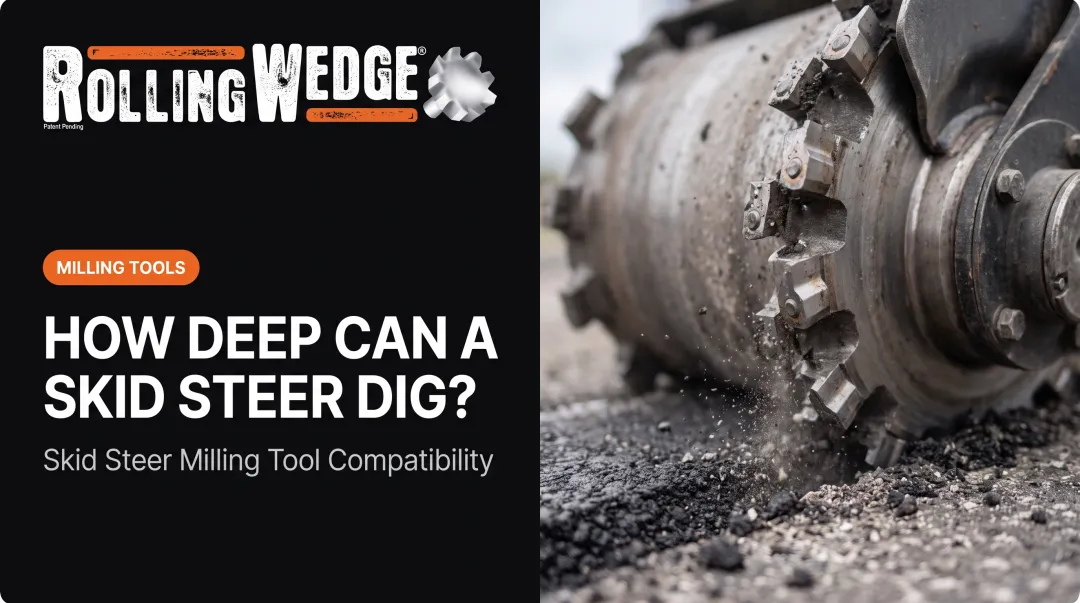
Traditional carbide-based cutting tools wear down fast on reinforced or mixed-material surfaces. Carbide picks run hot, and reinforcing mesh can snag and stall the drum. Rebar is known to stop a pick drum cold.
Picks are designed to rotate for longer life, but they often freeze in their holders. A broken pick can leave humps that telegraph straight through into the finished surface.
Rolling Wedge built its tooling to solve those failure modes.
The Rolling-Wedging-Lifting Approach
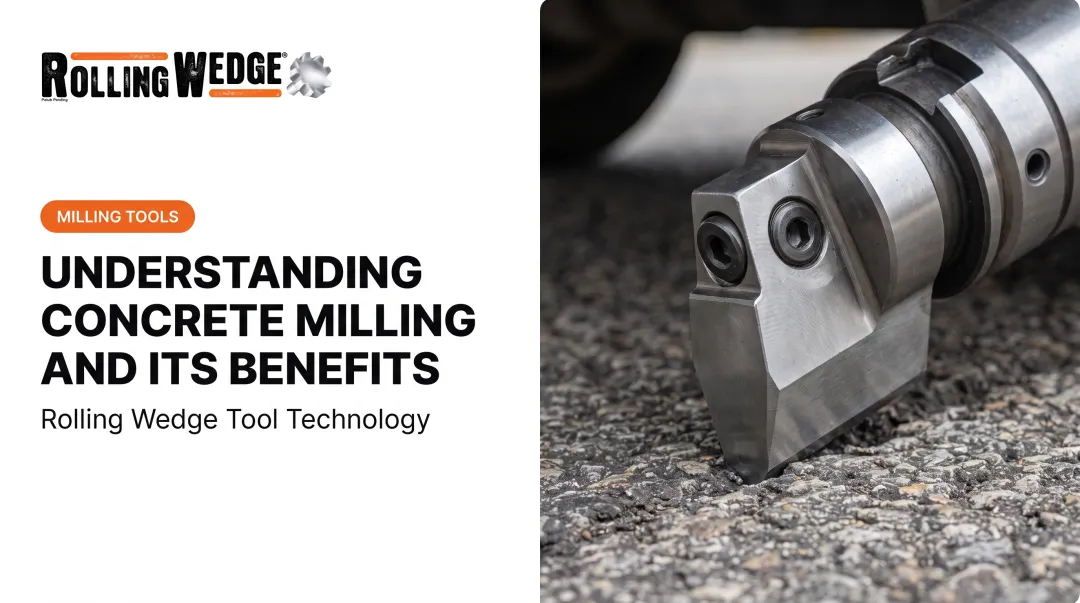
Rolling Wedge's patented RW103-B milling tool uses a rolling-wedging-lifting cutting action instead of a static carbide edge. The design exploits concrete and asphalt's low tensile strength, reducing resistance during the cut. In practice, this means:
- Milling asphalt and concrete in the same pass, without stopping to swap tooling
- Cutting through rebar-reinforced concrete without jamming or stalling
- Operating without the excessive heat buildup that plagues carbide systems
Documented efficiency gains compared to traditional carbide picks:
- Replacement every 1-3 months, versus roughly twice a week for carbide picks
- Full drum changeout in about 20 minutes, versus 1-2 hours for carbide
- About a 10-to-1 lifespan advantage on asphalt milling applications (per stated warranty terms)
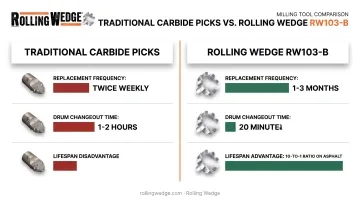
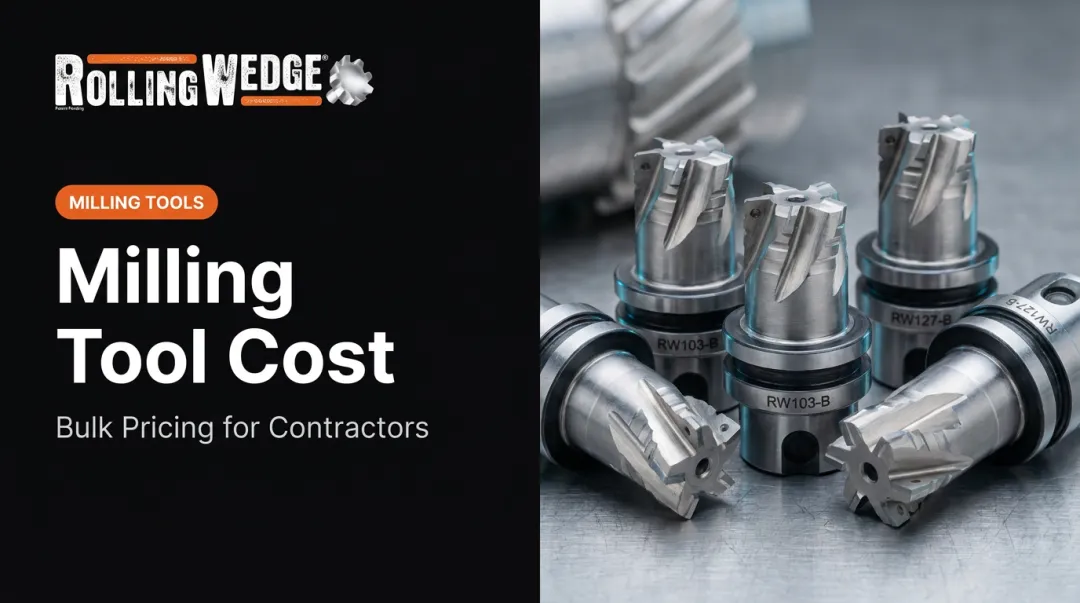
The RW103-B (2.5-inch diameter, nine carbide teeth) mounts via the RW127-B system. It works across skid steer platforms and larger milling rigs, including Roadtec and Caterpillar equipment, and has been confirmed on machines like the CAT 246D.
For contractors who want to test before committing, Rolling Wedge offers a two-week trial program for qualifying customers.
The Broader Innovation Trend
Tooling is not the only part of the jobsite changing. Battery-powered cutters are gaining ground for lower maintenance and quieter operation. AI-driven estimating is showing up in contractor workflows as well: a Dodge/CMiC survey found 51% of contractors evaluating AI tools, though reliability concerns remain common.
For milling crews, the practical payoff is the same across these shifts: less downtime, fewer tool swaps, and equipment that can handle mixed material on-site, rebar included.
Frequently Asked Questions
How much does interstate concrete cutting cost?
Costs vary widely based on depth, reinforcement, accessibility, and region—there's no flat national rate. Get a site-specific quote after the contractor confirms actual slab conditions.
Can concrete be cut horizontally?
Yes. Flat/slab sawing is the standard technique for horizontal cuts, commonly used for joints, removal sections, and trench boundaries.
How deep will a 20-inch concrete saw cut?
It depends on the specific saw model, not just blade radius. The Diamond Products CC1800XL, for example, is rated for a 7-5/8-inch maximum depth with a 20-inch blade.
What's the difference between wall sawing and wire sawing?
Wall saws cut precise vertical or horizontal openings in reinforced walls using a track-mounted blade. Wire sawing uses a diamond wire loop for oversized, curved, or oddly shaped structures a blade can't access.
Why are demolition robots becoming popular in concrete cutting businesses?
Remote-controlled robots keep operators away from unstable structures, dust, and debris while working in confined spaces where manual crews struggle. Vendors report significant speed gains, though results vary by machine and material.